
When a service business wants more leads, the first reaction is often to increase traffic. More SEO content. More ad spend. More keywords. More social posts.
But traffic is only one part of the lead-generation system. If the wrong people arrive, if the landing page is unclear, if the call to action is weak or if enquiries are not tracked properly, buying more traffic can simply make the inefficiency more expensive.
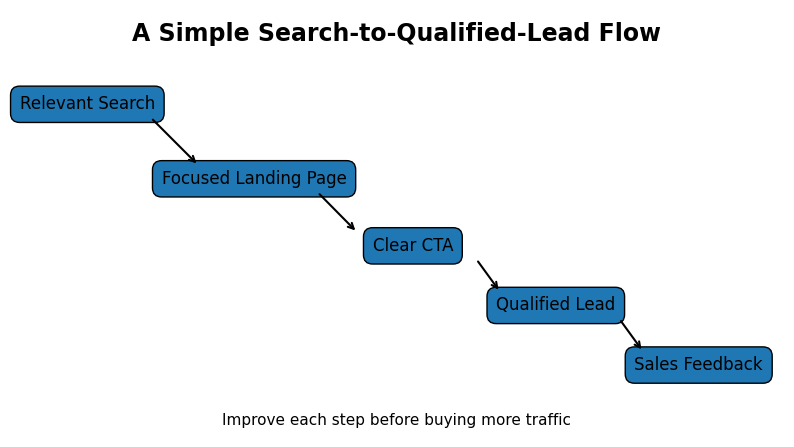
For many small service businesses, the better first move is to improve what happens between the search and the enquiry.
That means matching search intent to the right page, reducing friction, making contact options obvious and measuring which visitors actually become qualified leads.
The following framework can improve lead quality without requiring a larger advertising budget.
1. Separate Traffic Growth From Lead Growth
A website can receive more traffic without generating more business.
An SEO article may rank for a broad informational keyword and bring thousands of visitors who have no intention of hiring anyone. A paid campaign may generate many clicks from people searching for jobs, free tools or courses.
This is why traffic should be divided into two broad groups:
- Relevant demand: visitors who could realistically need the service.
- Incidental traffic: visitors whose search overlaps with the topic but not the business offer.
The first group matters commercially. The second may still support awareness, but it should not be mistaken for lead demand.
A simple monthly report should therefore show qualified leads alongside clicks and sessions.
2. Match Every Search Theme to One Clear Landing Page
Searchers should not have to restart their research after clicking.
If someone searches for WordPress development, the destination should focus on WordPress development. If someone searches for local SEO, the page should explain the local SEO service. If someone searches for a specific city, the page should explain whether and how the business serves that location.
Sending every visitor to the homepage creates unnecessary work for the customer.
A stronger structure gives each important commercial intent one clear primary page. This also improves SEO architecture because related keywords can be grouped around one strong URL instead of being spread across several thin pages.
3. Make the First Screen Answer Four Questions
The first screen of a service page should help the visitor understand four things quickly:
- What service is offered
- Who it is for
- What outcome or problem it addresses
- What the visitor should do next
This does not require a complicated hero section. A clear headline, a short supporting explanation, one trust signal and one primary call to action can be enough.
Avoid vague opening language such as “Transform your digital future” when the visitor searched for a specific service. Clarity usually converts better than cleverness because it reduces uncertainty.
4. Choose One Primary Call to Action
Many service websites display too many equal choices. Call now. WhatsApp. Email. Book a demo. Download a brochure. Fill the form. Follow on Instagram.
All of these can be useful, but one should be the primary action for the page.
A local service may prioritize calls. A web agency may prioritize WhatsApp or a project enquiry. A consultant may prioritize a booked meeting.
The primary action should be visible early, repeated at logical points and easy to use on mobile. Secondary contact options can remain available without competing visually with the main path.
5. Improve Forms for Lead Quality, Not Just Completion Rate
The shortest form does not always produce the best leads.
A form with only name and phone number may increase submissions, but it can also create more low-quality follow-up work.
For a service business, useful qualifying fields might include:
- Service required
- Business name
- Current website
- Project timing
- Short requirement description
Do not ask for information that is not needed at the first stage. The goal is to collect enough context for a meaningful response without turning the enquiry into a long application.
6. Use WhatsApp Carefully
WhatsApp can reduce friction, especially for mobile visitors, but it should still be structured.
A generic “Hi” message forces the business to restart the qualification process. A better WhatsApp link can prefill a short message such as:
“Hi, I’m interested in WordPress website development. My business is ___ and I’d like to discuss ___.”
This helps the customer begin the conversation and gives the business useful context.
The team should also decide who responds, during which hours and how enquiries are recorded. A convenient channel becomes much more valuable when the follow-up process is consistent.
7. Add Trust Beside the Decision Point
Trust should appear where the customer is deciding whether to make contact.
Useful proof can include:
- Genuine customer reviews
- Relevant projects
- Case studies
- Platform expertise
- Certifications where meaningful
- Process transparency
- Clear service boundaries
Avoid generic badges or unsupported statements such as “No. 1 agency.” Specific evidence is easier to evaluate.
For example, a project screenshot with a short explanation of what was built can be more useful than a large “trusted by hundreds” claim with no supporting detail.
8. Remove Price Ambiguity Where Possible
Service businesses do not always need to publish a fixed price. However, complete price ambiguity can create poor-quality leads.
If scope varies, explain what affects price. For example:
- Number of pages
- Ecommerce functionality
- Custom integrations
- Content requirements
- Design complexity
- Ongoing support
A starting price or typical range can also help where commercially appropriate. The objective is not to disclose every pricing detail. It is to help customers understand whether the service is broadly suitable before contacting the business.
9. Use Negative Keywords in Paid Search
If Google Ads is part of the lead mix, negative keywords can protect a limited budget.
A service business may need to exclude searches involving:
- Jobs
- Salary
- Courses
- Free software
- Templates
- Tutorials
- Definitions
- DIY instructions
The exact negatives depend on the campaign. Search-term reports should be reviewed regularly to identify recurring irrelevant intent.
A better landing page cannot recover money already spent on a click from someone who never wanted the service.
10. Use Search Console to Improve Organic Landing Pages
Search Console shows the real queries that cause pages to appear in Google.
For an important service page, review:
- Queries generating impressions
- Click-through rate
- Unexpected searches
- Multiple pages appearing for the same query
- Location modifiers
- Questions customers repeatedly search
This can reveal opportunities to improve headings, FAQs, titles, internal links and page structure. It can also reveal when a page is attracting the wrong intent.
SEO improvement should not mean adding every query to the copy. It should mean understanding what potential customers are looking for and deciding whether the page is the right answer.
11. Track Calls, Forms and Messaging Separately
If every contact action is grouped into one generic “conversion” number, the business loses useful information.
Track the primary channels separately. For example:
- Phone calls
- Contact forms
- WhatsApp clicks
- Appointment bookings
- Email enquiries
Then compare lead quality.
A campaign that generates many WhatsApp clicks may look successful, but the result is different if most chats are irrelevant. Channel-level tracking helps identify which conversion paths deserve more attention.
12. Add Sales Feedback to Marketing Reviews
Marketing data explains what happened before the enquiry. Sales conversations explain what happened after it.
Each month, record a few simple observations:
- Which services produced the strongest leads
- Which enquiries were poor fits
- Common customer questions
- Recurring objections
- Words customers used to describe their problem
This information can improve ads, SEO pages, FAQs and forms.
One of the easiest ways to improve digital marketing is to connect the people generating leads with the people handling them.
13. Improve Existing Pages Before Buying More Traffic
If a page already receives relevant traffic, improving it can be more efficient than increasing spend.
Review:
- Headline clarity
- Mobile experience
- Trust signals
- Call-to-action placement
- Form length
- Pricing expectations
- Service scope
- Page speed
- Contact functionality
Make one or two meaningful changes and measure the result. A page that converts better makes every existing SEO visit and paid click more valuable.
14. Measure Qualified Lead Rate
A useful metric for service businesses is qualified lead rate.
Qualified lead rate = qualified leads ÷ total leads.
Suppose a website generates 100 enquiries but only 15 are realistic customers. A campaign with 50 enquiries and 25 qualified prospects is commercially stronger even though the raw lead volume is lower.
This metric encourages better targeting and better qualification. It also prevents marketing teams from optimizing for cheap conversions that create work but little revenue.
Conclusion
More traffic is useful only when the website is ready to turn relevant visitors into meaningful conversations.
For service businesses, lead growth often begins with better alignment rather than a larger budget. Match search intent to the right page. Make the offer clear. Choose one primary action. Improve forms. Add genuine trust. Track each contact path. Use Search Console and paid-search data to refine intent. Ask sales teams which leads are actually useful.
When the website and marketing funnel work together, existing traffic can produce more qualified demand before the business spends another rupee on acquisition.
About the author: Archana Yadav is the founder of Vylino, a website development and SEO company helping small businesses improve websites, local search visibility and lead-generation journeys.
Guest article prepared for TeamLMM.


